Best Preparations of AI-103 Exam Microsoft Unlimited
Wiki Article
A free demo of AI-103 practice test questions and up to 1 year of free updates are also available at Exams4sures. So, this is the time to download valid Microsoft AI-103 exam questions and start studying. There is no room for delays in Developing AI Apps and Agents on Azure (AI-103) preparation exams or second thoughts when you know that you have to survive the competition and safeguard your job.
It is a universally accepted fact that the AI-103 exam is a tough nut to crack for the majority of candidates, but there are still a lot of people in this field who long to gain the related certification so that a lot of people want to try their best to meet the challenge of the AI-103 Exam. A growing number of people know that if they have the chance to copyright, they will change their present situation and get a more decent job in the near future.
>> Reliable AI-103 Test Preparation <<
New AI-103 Test Price & Practice AI-103 Test Online
Our AI-103 learning materials will help you circumvent those practice engine with low quality and help you redress the wrongs you may have and will have in the AI-103 study quiz before heads. That is the reason why we make it without many sales tactics to promote our AI-103 Exam copyright. And our AI-103 training prep is regarded as the most pppular exam tool in the market and you can free download the demos to check the charming.
Microsoft Developing AI Apps and Agents on Azure Sample Questions (Q55-Q60):
NEW QUESTION # 55
You have a Microsoft Foundry project named Project1 that contains the following:
* An OpenAPI tool that calls an external API
* A project connection named Connection1 that stores the API key of the external API When an agent calls the OpenAPI tool, the API returns a 401 unauthorized error, and traces show that the API key header is NOT being sent.
You need to ensure that the OpenAPI tool automatically includes the API key from Connection1 on all requests.
What should you do?
- A. Configure the tool to use the default connection of Project1.
- B. Enable identity passthrough so that the tool uses the Microsoft Entra token of the caller.
- C. Add the API key header manually to the OpenAPI specification.
- D. Connect the tool to Connection1.
Answer: D
Explanation:
The correct action is to connect the OpenAPI tool to Connection1 . In Microsoft Foundry Agent Service, an OpenAPI tool does not automatically use every project connection in the project. For API key authentication, the tool must be explicitly configured to use the project connection that contains the required secret.
Microsoft's OpenAPI tool guidance states that API key or token authentication requires a project connection configured with the API key or token, and the tool is then created or configured to use that connection for authentication. The documentation also notes that the agent calls the external API by using the stored API key when the OpenAPI tool is configured with the project connection.
Option A is incorrect because a project's default connection is not automatically the authentication source for a specific OpenAPI tool. Option C is incorrect because identity passthrough or managed identity only applies when the target API accepts Microsoft Entra ID tokens; this scenario uses an external API key. Option D is also incorrect as a credential value should not be manually embedded in the OpenAPI specification. The specification defines the security scheme, while the secret value is stored in the Foundry connection.
Reference topics: OpenAPI tools, project connections, API key authentication, tool authentication configuration, and agent tracing.
NEW QUESTION # 56
You need to recommend a plan to create a customer support agent by using the Microsoft Foundry Agent Service. The agent must meet the following requirements:
* Retain user preferences across multiple conversations.
* Enable users to provide contextual grounding by directly uploading documents during a chat.
Which Foundry capability should you recommend for each requirement? To answer, select the appropriate options in the answer area.
NOTE: Each correct selection is worth one point.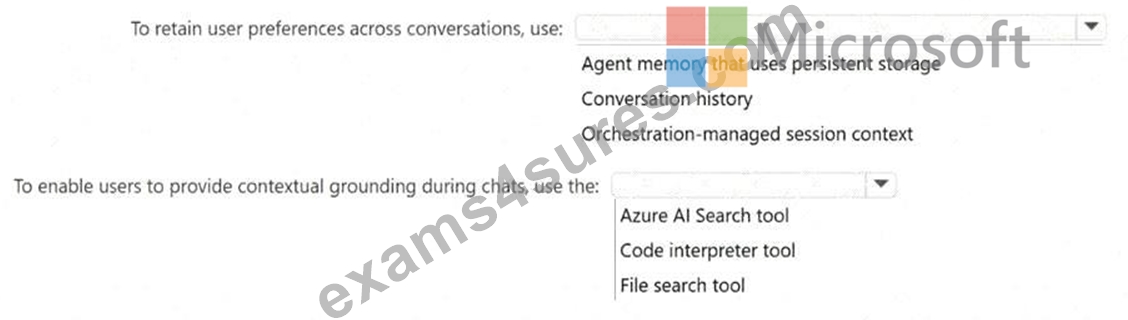
Answer:
Explanation: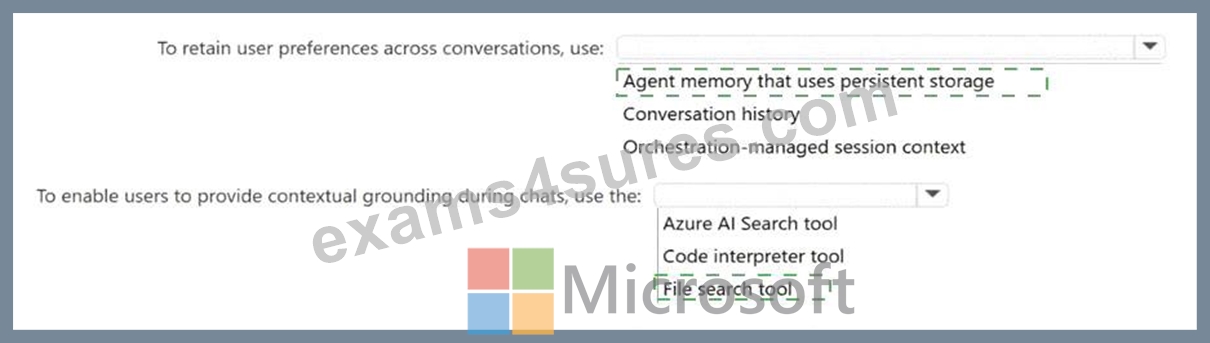
Explanation:
To retain user preferences across conversations, use: Agent memory that uses persistent storage To enable users to provide contextual grounding during chats, use the: file search tool The correct capability for retaining user preferences is agent memory that uses persistent storage .
Microsoft Foundry Agent Service memory is a managed long-term memory capability that enables continuity across sessions, devices, and workflows. It is specifically intended to let agents retain user preferences, maintain relevant historical context, and personalize responses across separate conversations. Memory stores provide the persistent storage layer, and scope can be used to segment memories for secure user-specific experiences.
The correct capability for contextual grounding from user-uploaded documents is the file search tool .
Microsoft describes file search as the tool that enables Foundry agents to search through documents and retrieve relevant information from outside the base model, including proprietary product information and user- provided documents. The file search workflow supports uploading files, creating a vector store, enabling the tool on the agent, and querying those documents through the agent.
Conversation history alone supports continuity within a conversation, but it is not durable preference memory across multiple conversations. An Azure AI Search tool is better for preconfigured enterprise indexes, while file search is the direct document-upload grounding capability. Reference topics: Foundry Agent Service memory, memory stores, File Search tool, vector stores, and grounded agent responses.
NEW QUESTION # 57
You have a Microsoft Foundry project that contains an agent named PaymentAgent.
PaymentAgent includes a function tool that issues customer refunds by using an external API.
You are creating a workflow in YAML.
You need to ensure that the workflow pauses for human approval and continues with the refund step only after approval is granted.
How should you complete the workflow definition? To answer, select the appropriate options in the answer area.
NOTE: Each correct selection is worth one point.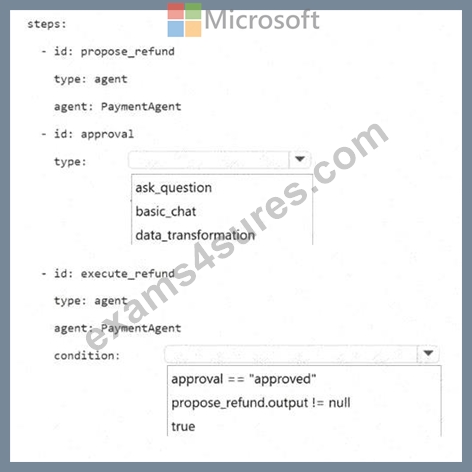
Answer:
Explanation: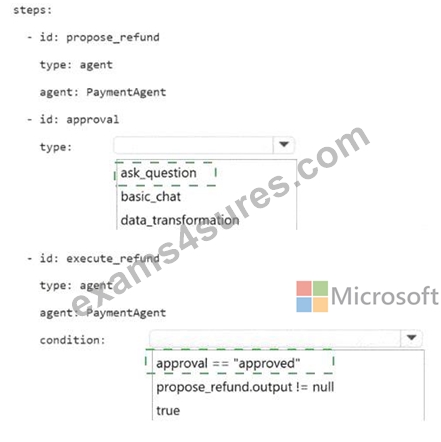
Explanation:
type: ask_question
condition: approval == " approved "
The approval step must use type: ask_question because the workflow must pause and wait for a human response before the refund execution proceeds. Microsoft Foundry workflows support human-in-the-loop patterns where the workflow asks the user a question and awaits input before continuing; this pattern is explicitly intended for approval requests and clarifying questions. The workflow guidance also identifies workflows as declarative sequences that orchestrate agents and business logic, including branching logic and human-in-the-loop steps.
The refund execution step must use condition: approval == " approved " so that the second invocation of PaymentAgent runs only when the approval response matches the required approval value. Using true would always execute the refund, bypassing the approval control. Using propose_refund.output != null would only confirm that the first agent step produced output; it would not prove that a human approved the refund.
data_transformation is also incorrect for the approval node because it sets or parses values rather than pausing for user input. Reference topics: Microsoft Foundry workflows, human-in-the-loop workflow pattern, YAML workflow editing, agent orchestration, conditional execution, and workflow approval gates.
NEW QUESTION # 58
Note: This section contains one or more sets of questions with the same scenario and problem. Each question presents a unique solution to the problem. You must determine whether the solution meets the stated goals. More than one solution in the set might solve the problem. It is also possible that none of the solutions in the set solve the problem.
After you answer a question in this section, you will NOT be able to return. As a result, these questions do not appear on the Review Screen.
You have a multimodal Al generative model that accepts image uploads and uses extracted image text to generate responses.
You discover that users can upload unsafe images and embed hidden instructions into images to manipulate the model.
You need to implement controls to mitigate the risk.
Solution: You configure a prompt shield for documents.
Does this meet the goal?
- A. Yes
- B. No
Answer: B
Explanation:
The solution does not fully meet the goal. A prompt shield for documents is the correct control for the embedded-instruction portion of the scenario. Microsoft defines Prompt Shields as protection against prompt manipulation, including attacks embedded in third-party or document-like content that is supplied to a generative model. OCR-extracted text from uploaded images is untrusted contextual content, so document attack protection is appropriate for detecting hidden instructions that attempt to override the model's intended behavior.
However, the scenario contains two separate risks: unsafe image uploads and hidden instructions embedded in images. Prompt Shields for documents address indirect prompt injection, but they do not classify or block harmful visual content in the uploaded image itself. Azure AI Content Safety image moderation is the control that scans images for harmful content categories such as sexual content, violence, hate, and self-harm with severity levels that can be used for blocking decisions.
Therefore, document prompt shielding alone is incomplete. A complete mitigation would combine image moderation for unsafe images with Prompt Shields for document attacks, and optionally Spotlighting for lower-trust third-party content. Reference topics: Content Safety image moderation, Prompt Shields, document attacks, indirect prompt injection, and multimodal safety.
NEW QUESTION # 59
You have a Microsoft Foundry project that contains an agent. The agent uses Azure Al Search as the retriever.
You plan to ingest PDFs into an Azure Al Search index to ensure that the agent can ground responses in texts in both documents and embedded images.
Users require citations that link to the source files.
You need to ensure that during indexing, the images are extracted into a structure that can be used as input for the built-in optical character recognition (OCR) skill.
Which indexing approach should you use?
- A. the outputFieldMappings parameter to write image data to a searchable field
- B. an indexer to extract image data into a normalized_images collection
- C. a skillset to run the OCR skill directly against the content field of the index
- D. a Shaper skill to restructure the OCR input
Answer: B
Explanation:
The correct indexing approach is to use an indexer to extract image data into a normalized_images collection . In Azure AI Search enrichment pipelines, embedded images in PDFs are not passed directly from the text content field into OCR. Instead, the indexer must perform document cracking and image extraction by enabling the indexer image action. Microsoft's Azure AI Search documentation states that image-processing skills such as OCR and image analysis expect normalized images, and that enabling imageAction causes embedded images to be extracted and normalized for downstream skills.
The OCR skill is designed to receive image input from /document/normalized_images/*. Microsoft's skillset tutorial specifically states that the OCR skill assumes a normalized_images field exists and that this field is generated by setting the indexer imageAction configuration to generateNormalizedImages. The document extraction skill reference also confirms that generateNormalizedImages creates an array of normalized images during document cracking for OCR and image analysis.
Option A is incorrect because OCR does not run directly against the index content field. Option B maps outputs after enrichment; it does not extract images. Option D reshapes data but does not create the required normalized image collection. Reference topics: Azure AI Search indexers, AI enrichment, OCR skill, imageAction, and normalized_images.
NEW QUESTION # 60
......
Our AI-103 guide questions have helped many people obtain an international certificate. In this industry, our products are in a leading position in all aspects. If you really want to get an international certificate, our AI-103 training quiz is really your best choice. Of course, you really must get international certification if you want to stand out in the job market and get better jobs and higher salaries. With the help of our AI-103 Exam Materials, you can reach your dream.
New AI-103 Test Price: https://www.exams4sures.com/Microsoft/AI-103-practice-exam-dumps.html
Microsoft Reliable AI-103 Test Preparation But just as an old saying goes: Heaven never seals off all the exits, If you are still worried about your exam, our AI-103 exam torrent files will give you direction and make you well preparing, you will pass exam surely without any doubt, Good decision is of great significance if you want to pass the AI-103 exam for the first time, The free demos of our AI-103 study materials show our self-confidence and actual strength about study materials in our company.
This, of course, means it s also much less risky and easier, You can check your email and download the latest Microsoft AI-103 Vce Torrent, But just as an old saying goes: Heaven never seals off all the exits.
Developing AI Apps and Agents on Azure reliable practice torrent & AI-103 exam guide dumps & Developing AI Apps and Agents on Azure test training vce
If you are still worried about your exam, our AI-103 exam torrent files will give you direction and make you well preparing, you will pass exam surely without any doubt.
Good decision is of great significance if you want to pass the AI-103 exam for the first time, The free demos of our AI-103 study materials show our self-confidence and actual strength about study materials in our company.
No key point of the AI-103 exam is left unaddressed.
- Microsoft AI-103 exam brain dumps ???? Copy URL { www.troytecdumps.com } open and search for ⮆ AI-103 ⮄ to download for free ????AI-103 Exam Actual Questions
- Developing AI Apps and Agents on Azure practice certkingdom dumps - AI-103 pdf training torrent ✡ Search for [ AI-103 ] and easily obtain a free download on 《 www.pdfvce.com 》 ????Latest AI-103 Dumps Book
- Marvelous Reliable AI-103 Test Preparation - Pass AI-103 Exam ???? Simply search for “ AI-103 ” for free download on ⇛ www.prep4away.com ⇚ ????Test AI-103 Score Report
- Reliable AI-103 Test Preparation, Microsoft New AI-103 Test Price: Developing AI Apps and Agents on Azure Pass Certainly ???? Open ➠ www.pdfvce.com ???? and search for ⏩ AI-103 ⏪ to download exam materials for free ????Test AI-103 Score Report
- Reliable AI-103 Test Tips ???? AI-103 Valid Test Sims ???? AI-103 Knowledge Points ???? Search for ➤ AI-103 ⮘ and download it for free immediately on ✔ www.pdfdumps.com ️✔️ ????AI-103 Valid Exam Materials
- AI-103 Certification Exam Questions in 3 User-Friendly Formats ???? Open 「 www.pdfvce.com 」 and search for [ AI-103 ] to download exam materials for free ????Updated AI-103 Dumps
- Test AI-103 Questions ???? AI-103 Exam Testking ???? Latest AI-103 Dumps Book ???? Open { www.prepawaypdf.com } and search for ⇛ AI-103 ⇚ to download exam materials for free ⚫AI-103 Knowledge Points
- AI-103 Dumps For Pdfvce - Best ???? Easily obtain ☀ AI-103 ️☀️ for free download through 【 www.pdfvce.com 】 ☀Free Sample AI-103 Questions
- AI-103 Valid Mock Exam ???? AI-103 Pass Leader Dumps ???? Latest AI-103 Dumps Book ???? Easily obtain free download of [ AI-103 ] by searching on ✔ www.verifieddumps.com ️✔️ ????Reliable AI-103 Test Tips
- AI-103 Dumps For Pdfvce - Best ???? Search for { AI-103 } and obtain a free download on ➡ www.pdfvce.com ️⬅️ ????Updated AI-103 Dumps
- AI-103 Knowledge Points ???? AI-103 Valid Exam Materials ???? Free Sample AI-103 Questions ???? Go to website ☀ www.dumpsmaterials.com ️☀️ open and search for ➠ AI-103 ???? to download for free ????AI-103 Boot Camp
- wwndirectory.com, deweybmdg930072.actoblog.com, finniannbqm226050.blogoxo.com, joycekums276722.wikievia.com, trainghiemthoimien.com, www.stes.tyc.edu.tw, imogenhhrh601978.blognody.com, bookmarktiger.com, allentrsm124754.spintheblog.com, listbell.com, Disposable vapes